


How to Build a Review Generation System That Actually Works
- Tomasz Dylik
- Mar 16, 2025
- 4 min read


In the digital marketplace, customer reviews are pure gold. They're not just nice-to-have testimonials – they're conversion machines that can make or break your small business. But getting those reviews? That's where most of us hit a wall.
If you're tired of randomly asking customers for feedback and getting crickets in return, it's time to build a review generation system that actually delivers results. Not just any system – one that runs on autopilot while you focus on what you do best.
Why Most Businesses Fail at Getting Reviews
Let's face it: most review collection efforts are reactive and inconsistent. You remember to ask when a customer is super happy, forget when you're busy, and avoid it completely when things go sideways.
The truth? Only about 1 in 10 satisfied customers leave reviews without being prompted. But get this – when properly asked, that number jumps to nearly 70%.
The 5-Stage Review System Funnel That Changes Everything
The most successful small businesses implement what marketing experts call a "Review Funnel" – a systematic approach to gathering feedback at key touchpoints. According to research, implementing this methodology increases review volume by up to 300%.
Here's how to build yours:
Stage 1: Perfect Your Timing
Timing isn't just important – it's everything. Request reviews at these golden moments:
Right after a positive comment or compliment
When customers reorder or return (they already trust you)
Post-delivery when your product is creating value
After resolving an issue successfully (yes, really!)
Avoid asking when customers are rushed, frustrated, or before they've experienced your full value.
Stage 2: Create Your Review Request Templates
Your request message can make or break your response rate. The best messages:
Keep it short – Under 3 sentences performs best
Make it personal – Use their name and reference their purchase
Explain why – "Your feedback helps other shoppers find us"
Provide clear instructions – One specific action, not multiple options
Here's a template that converts:
Hey [Name], thanks for choosing [your business]! Would you mind taking 30 seconds to share your experience? It helps us improve and helps others find us too. Just tap here: [direct link]
Stage 3: Build Your Automation System
This is where your review generation transforms from occasional to consistent. According to the "Presence Quadrant" model, businesses using automation see 47% higher customer retention rates.
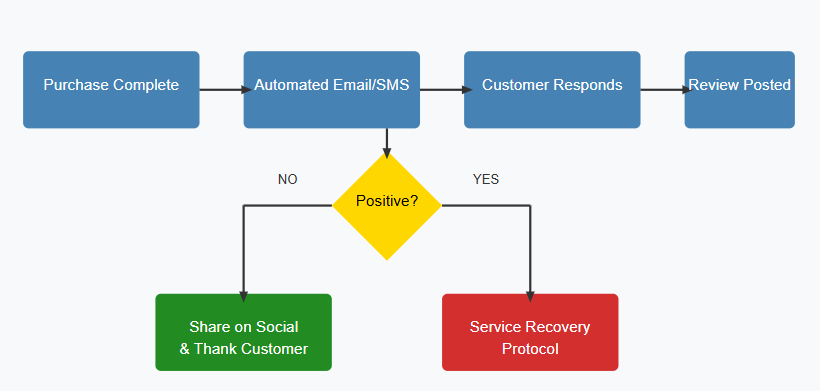
Here's how to set it up:
Choose your trigger event – Purchase confirmation, delivery notification, or service completion
Select your delivery channel – Email, SMS, or in-app notifications (SMS has 98% open rates)
Set up your automation tool – Options include:
Basic: Zapier + Gmail/SMS
Intermediate: Yotpo or Podium
Advanced: Integrated CRM solutions
For example, a consulting firm could use Zapier to connect their project management system with Mailchimp, triggering review requests when projects move to "Complete" status.
Stage 4: Direct to the Right Platforms
Not all review platforms are created equal. Focus your efforts where they matter most:
Google Business Profile – Critical for local businesses
Industry-specific platforms – G2 for SaaS, TripAdvisor for hospitality
Social proof widgets – Embed reviews directly on your site
Pro tip: Always send customers directly to the review platform in one click. Every extra step cuts your completion rate by 50%.
Stage 5: Response & Amplification
What you do after receiving reviews matters just as much as getting them:
Respond to every review within 24 hours – Even the negative ones
Repurpose positive reviews as social content – Turn them into graphics
Create review highlights for your website – Focus on specific benefits
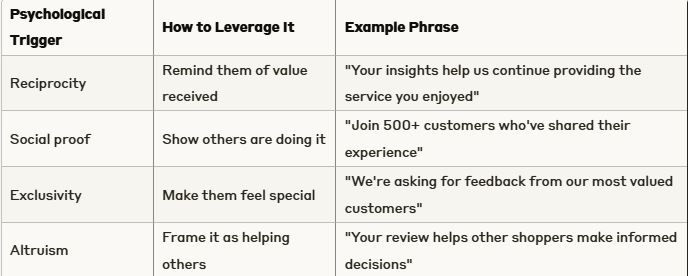
The Psychology Behind Effective Review Requests
Understanding why people leave reviews helps you craft more effective requests:
Tools That Make Review Generation Effortless
The right technology makes all the difference:
Collection tools:
Yotpo – Automated email sequences with AI-optimized timing
Podium – SMS-based review requests (highest conversion)
GatherUp – Multi-platform review management
Monitoring tools:
Brand24 – Real-time review alerts with sentiment analysis
Mention – Track brand mentions across platforms
Response tools:
Reputation.com – Templated responses with personalization
Buffer – Schedule and track social shares of reviews
Turning Negative Feedback into Gold
When you get that inevitable one-star review, don't panic. According to research from a leading health and beauty retailer, businesses that respond effectively to negative reviews see 41% of complainers convert into loyal advocates.
Here's the 3-step recovery process:
Respond publicly – Acknowledge concerns and show you care
Take it private – Move to direct message to resolve the issue
Follow up – After resolution, kindly ask if they'd update their review
The Numbers That Matter: Tracking Success
Keep an eye on these metrics to ensure your system is working:
Review velocity – Number of new reviews per month
Star rating trend – Is your average improving?
Response rate – Percentage of customers who leave reviews when asked
Platform distribution – Ensure reviews aren't all on one platform
A good benchmark: Aim for 30+ new reviews per quarter with an average rating above 4.7 stars.
Common Review Generation Mistakes to Avoid
Don't fall into these traps:
Asking too early – Before the customer experiences value
Making it complicated – Requiring accounts or multiple steps
Sending generic requests – Not personalizing the message
Ignoring negative feedback – Missing improvement opportunities
Incentivizing reviews – Often violates platform terms of service
Start Simple, Scale Over Time
You don't need to implement everything at once. Begin with:
Week 1: Create your basic templates
Week 2: Set up Google Business Profile alerts
Week 3: Implement your first automation (email or SMS)
Week 4: Create a response process for all reviews
During my time managing digital presence for a leading health and beauty retailer, we found that consistent implementation of even basic systems increased review volume by 278% within three months.
Conclusion: Reviews as Ongoing Relationships
The most successful businesses see reviews not as one-off transactions but as ongoing relationship-building opportunities. Your review generation system is really a customer feedback loop that continuously improves your business.
Remember: 92% of consumers verify online reputation before initial purchases, making consistent, value-driven engagement non-negotiable. Those who master this balance won't just survive – they'll define the next era of digital commerce.
Ready to take your local search game to the next level?
Download my free "Win Local Search" workbook to complement your review generation system with targeted SEO strategies.


Comments